
 Previous
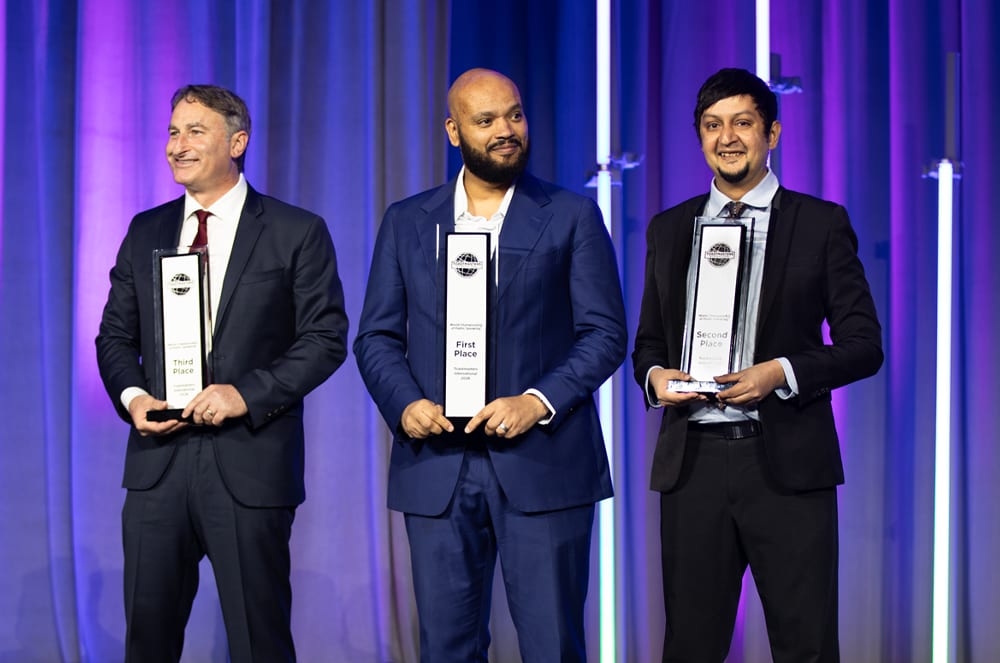
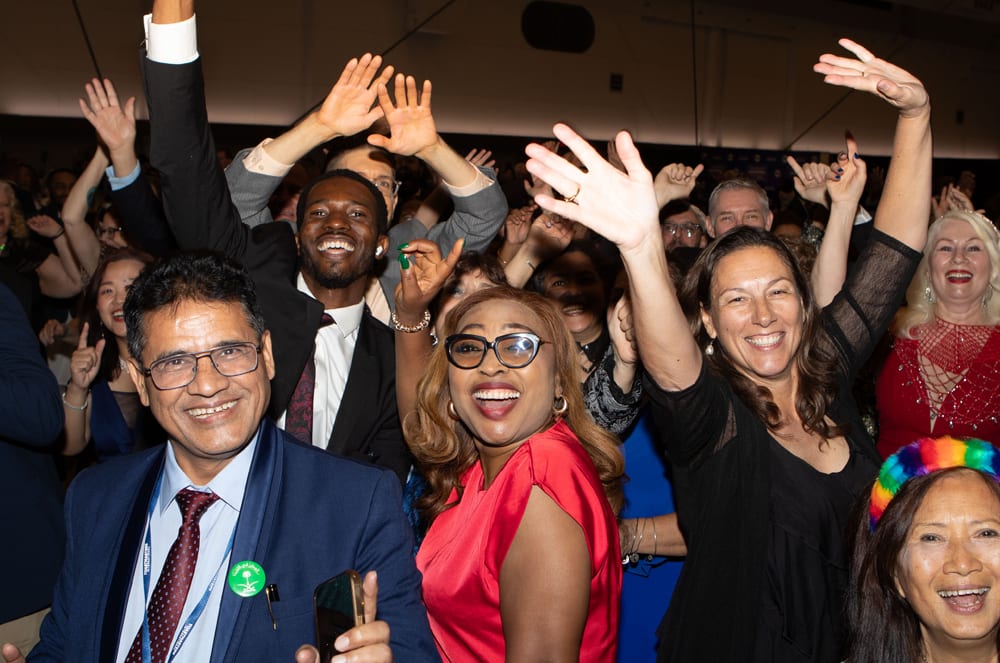
Attendees at the Toastmasters 2026 International Convention in Vancouver, Canada, savored opportunities as wide open as the mountains that formed a scenic backdrop to the event. And the three winners of the World Championship of Public Speaking® delivered speeches as expansive as the peaks themselves, stretching from decision-making advice, to hurtful words and family ties, to grace under pressure amid a disastrous fire.
The event is the final stage of the International Speech Contest, which opens with competitions in Toastmasters clubs around the world. Winners advance through the Area, Division, District, quarterfinal, and semifinal contests.
Read ahead to learn about the top three finishers from this year’s convention.
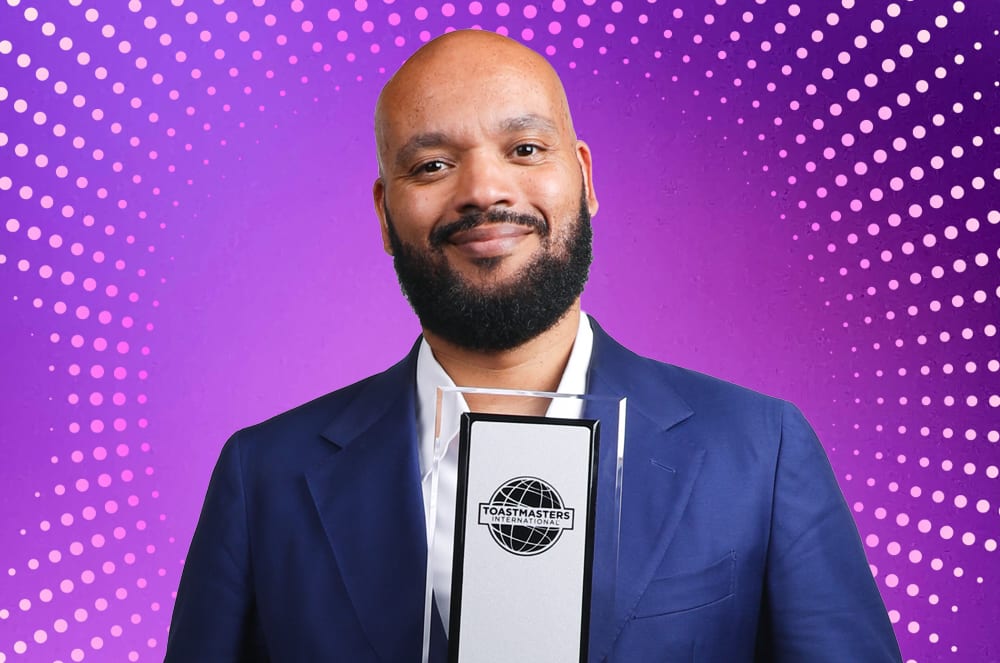
Dirceu “Didi” da Silva
By Laura Mishkind
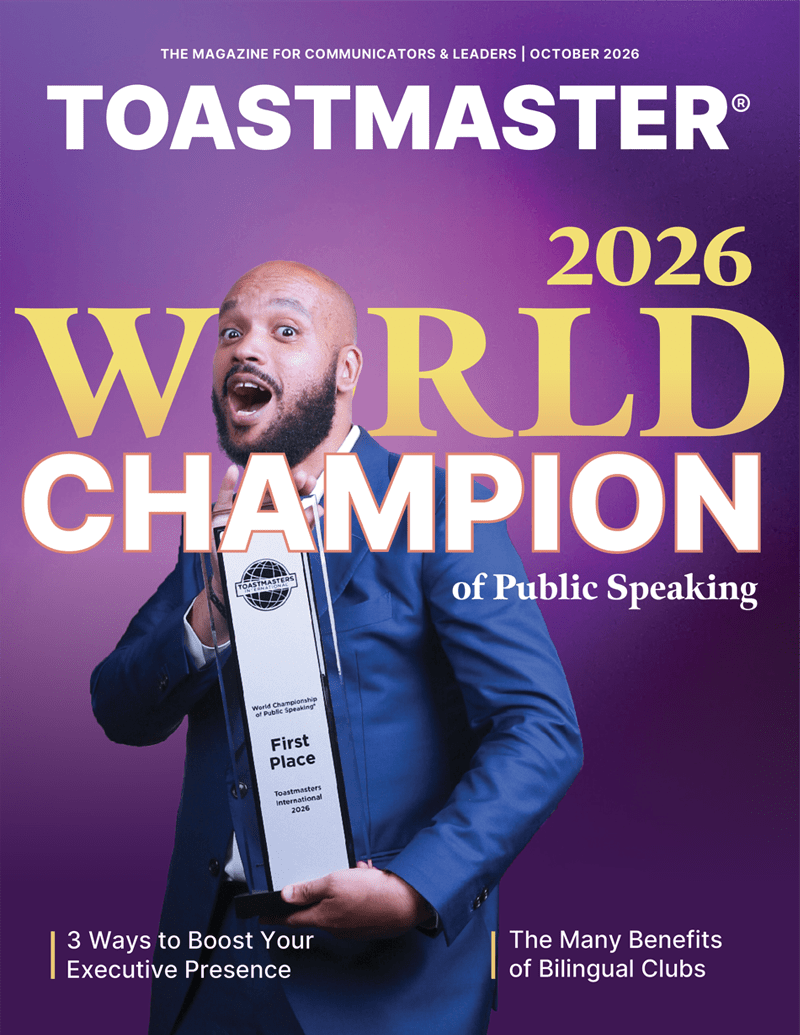
Dirceu “Didi” da Silva’s championship speech, “Best Decision Ever!” ended on a cliffhanger. Did his basketball fall through the net or bounce off the rim? Even after taking the title of World Champion of Public Speaking, he isn’t sharing the results of his championship game from years ago.
His reasoning for keeping the secret? “This really stuck with people just because of the curiosity. It’s not a deeply emotional story, but curiosity made it so that people would remember it.” Plus, “some of the magic will go away if I answer that question.”
On the final stage, da Silva of Rotterdam, Netherlands, walked the audience through a few critical seconds on the basketball court and tied the story into a lesson about decision-making. From deciding whether or not to take the shot to hesitating on a study-abroad opportunity, the 2026 speaking champ highlighted why it is so important to take hold of our lives and make a decision before it is made for you.
“Decision-making is a very relatable topic,” da Silva says. “We’re making decisions all day long. It’s a huge part of life. And sometimes we worry too much. I hope I don’t make the wrong decision. And when you’re stuck in that loop, in that mindset, sometimes people don’t make a decision at all.” Which leaves the issue entirely beyond your control.
Training and Speaking
He brings this lesson to his work as a corporate trainer as well—often in workshops for teenage students. Da Silva focuses his curriculum on communication and other soft skills and enjoys the opportunity to make an impact. He’s been working in the training space since he was 19 years old.
But according to him, public speaking and training are two very different things. “They have the same elements,” da Silva explains. However, when he got started as a trainer, he says, “It was just based on, ‘You know a lot about this stuff, so go train other people.’ That was definitely not the right way to train. So I started focusing on the skills I needed to not just transfer knowledge, but also make people want to use that knowledge.” He joined Toastmasters because he needed stronger public speaking skills, not because he was nervous onstage.
“Sometimes when I speak, I have a lot on my mind, and I go from here to there. It’s very unstructured. I joined Toastmasters to bring more structure in the way that I communicate, and I’ve loved it ever since.”
While he was improving his skills, da Silva also admits that he’s very competitive, so as soon as he learned about speech contests, he wanted in. During his first year as a Toastmaster in Sprekershaven Toastmasters Rotterdam, he signed up for the Dutch-language contest (he couldn’t compete in the club contest since he hadn’t completed enough speeches yet).
A year later, in 2015, he advanced to earn third place at the District contest level. And in a full-circle moment (and a great decision), da Silva says that 2015 speech was the first draft of the speech that he ultimately took to the World Championship stage. Of course, it has seen many iterations over the years and been refined and modified to make it an original speech he could share with the world.
A Network of Support
Da Silva was inspired to use the “Best Decision Ever!” speech by 2025 World Champion and good friend Sabyasachi “Saby” Sengupta. The two officially met at the 2015 District competition in Lisbon, Portugal. They both competed and then went on a road trip to support that year’s first-place finisher.
In the car they talked about their mutual desire to become the World Champion of Public Speaking, and every year they continued to check in with one another to see if they were both competing. “We were always supportive, but also keeping each other sharp,” da Silva shares. “I knew if Saby was also competing that I had to bring my A game.”
When Sengupta took the title in 2025, da Silva admits that he thought his friend would be too busy to help him. But Sengupta reached out to see if da Silva was planning to compete, and offered up his help, assuring him he was never too busy for a friend.
That support became vital to da Silva’s success. Talking to someone who had been through the entire speech contest process helped him maneuver the mental hurdles that came after advancing to each level. “The mental support is maybe even more valuable than just feedback on speeches,” da Silva explains.
Another fun tie-in for the friends is this year’s win means two years of back-to-back winners from the same region, District, and even small country. “I’m really proud I could contribute to that result,” da Silva says.
However, it also created some nerves. Da Silva thought that statistically, there was no way this could happen, which increased the pressure. But Sengupta helped him block out what he perceived as expectations from others and reframe it to see that everyone was excited and supportive of their Netherlands representative.

Listen to The Toastmasters Podcast to hear more from Didi da Silva.
Beyond his World Champion buddy, two other coaches supported da Silva every step of the way: John Zimmer and Presiyan Vasilev.
Da Silva and Zimmer met at a District speech contest, where Zimmer took first place, and da Silva second. After that, the two stayed in touch. Last year, Zimmer, a 2013 and 2018 semifinalist, coached Sengupta, and this year, he offered his help to da Silva, providing creative suggestions that made a big impact.
Vasilev, the 2013 World Champion of Public Speaking, coached da Silva prior to 2020, when da Silva took a break from competing. The two later reconnected, and Vasilev provided guidance with sculpting the speeches. Da Silva says the 2013 champion is a wordsmith, and the two different types of coaching styles complemented each other well and helped him succeed.
His wife and four children also served as a great support system and inspiration for his speech topics. “If I look back at all the speeches that I’ve done, not just for Toastmasters, but also outside of it, most of it is just my personal life. And a lot of them involve either my wife or my kids.”
Stories of the Everyday
When he first started competing, da Silva initially felt discouraged after noticing that the winning speeches were often about extraordinary events, and he hadn’t climbed Mount Everest or jumped out of a plane or survived a tragedy. It wasn’t until he heard future coach Vasilev’s winning speech about changing a tire that he felt inspired.
“I started challenging myself, thinking You don’t have to have this extraordinary experience in your life to be able to tell a speech and inspire people. You just need ordinary events that everybody can relate to,” he elaborates. “That’s the secret: Turn everyday things and ordinary things into extraordinary stories.”
Now that da Silva’s speech has had the ultimate impact and won him the World Championship of Public Speaking title, he is actually a little disappointed he can’t keep competing in Toastmasters speech contests. For years he has used the competitions to level up his speaking and storytelling skills. But now he’ll shift his focus. He says, “I think it’s up to me now to focus on helping others, whether it’s coaching or inspiring.”
His first step will be trying to accept many of the invitations to visit clubs and connect with Toastmasters around the world. Then he wants to explore if he can make a business out of speaking beyond his trainings.
“I’ve been asked as a keynote speaker on many different occasions, but it was never my core business, and now I want to explore those aspects,” da Silva shares. “I can see myself actually never getting tired of standing on a stage. I cannot imagine getting tired of that. I’m really looking forward to the next phase and whatever it may bring.”

Gurmeet Singh Gurcharan Singh
By Laura Amann
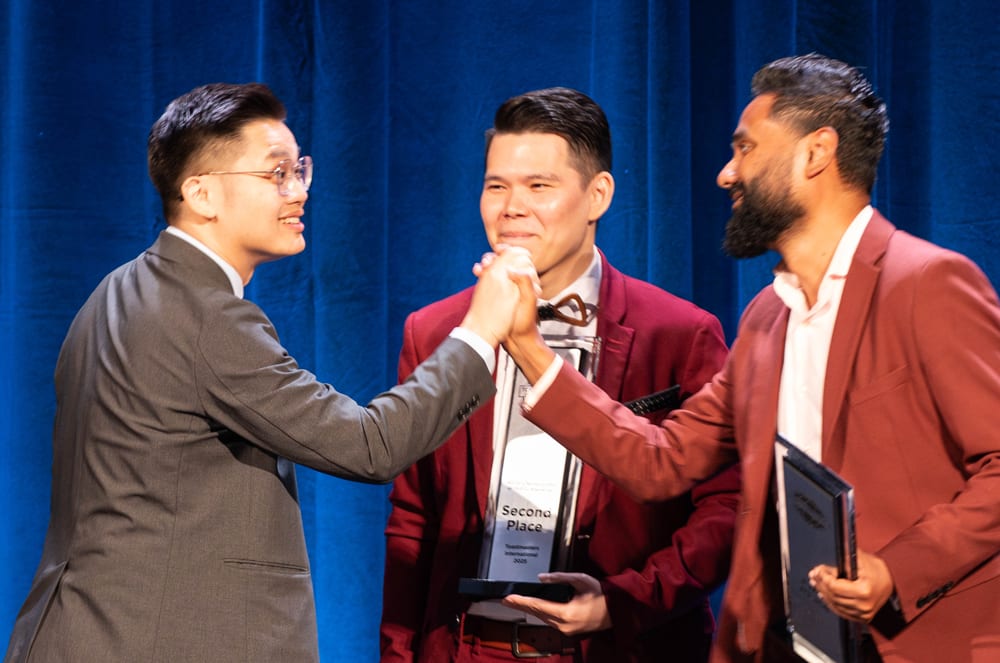
Despite the words that followed him for much of his life, in taking home the second-place trophy, Gurmeet Singh Gurcharan Singh proved he was good for something—namely public speaking.
His speech title, “Good for Nothing,” came from the words he first heard from a teacher, after he received a disappointingly low test score. Onstage, Singh demonstrated how his teacher had looked at him and slowly spat out the words she would continue to tell him over the years, “You are … good … for … nothing.”
Years later, his girlfriend told him the same thing, and one day he found himself saying those scornful words to his grandfather, the gentle man who raised him. Seeing how his grandfather didn’t let those angry words affect him, much less define him, changed Singh’s view.
He realized that one phrase can “shape us, hurt us, and ultimately teach us something about ourselves.” In fact, the words meant to hurt him actually led to something more meaningful. The school detentions he received for his poor grades were also where he met his best and lifelong friend, Sam. The girlfriend who didn’t appreciate him opened space in his life for him to meet his wife, Angelina Ha.
Delivering such a personal and vulnerable speech was his way of expressing his deep regret in never being able to apologize to his late grandfather, who died in 2009, while also showcasing the impact he made on his life.
His grandfather had taken on the role as father figure after Singh’s own father died when he was only 5. Having immigrated to Malaysia from India as a child, his grandfather had grown up poor, but he worked hard to provide for his family, saving money when he could, even if that meant compromising his own needs.
Singh credits him for “teaching me about life,” from a young age into adulthood, disciplining him, comforting him, and celebrating with him.
“My hope is that others will realize that we always have people in our corner who will root for our success,” he explains. “We are never really good for nothing, because we have always been good for someone.”
Singh, who lives in Kuala Lumpur, Malaysia, is a member of Elite Toastmasters Club. He joined Toastmasters in 2010 at the encouragement of his brother, who thought it would be a way for him to overcome his shyness. Despite his initial nerves—he couldn’t finish his first Table Topics® speech—he quickly embraced speech contests as a way to challenge himself to deliver better speeches.
He also jumped into a variety of club leadership roles, and steered his struggling club toward an increase in membership when he was Club President in 2013. But it is the speaking aspect of Toastmasters that has his heart.
Singh credits Toastmasters with helping him overcome his fear of public speaking and giving him the confidence to transition from a chef to a corporate trainer. Toastmasters also led him to discover his love for storytelling. When he first began giving speeches, he focused on becoming a better speaker, “but I soon realized that people don’t remember speeches, they remember the stories that make them feel something.” Once he uncovered that truth, storytelling became his passion.
Sam and Angelina were not just subjects in this speech—both were instrumental in helping Singh prepare for the contest, listening to his speech numerous times and offering their support. On the day of the contest, his wife and son were in Vancouver to cheer him on, while Sam watched from Australia, where he currently lives.
Since he began competing, Singh’s goal has been the same: delivering a better speech than the last. For people considering competing, he advises, “Do not go into the competition hyper focused on winning it; instead, deliver a better speech than your last one, while being proud of sharing a message that you feel strongly for.”
Asked what he will do next, Singh simply replies, “aim to deliver a better speech tomorrow.”
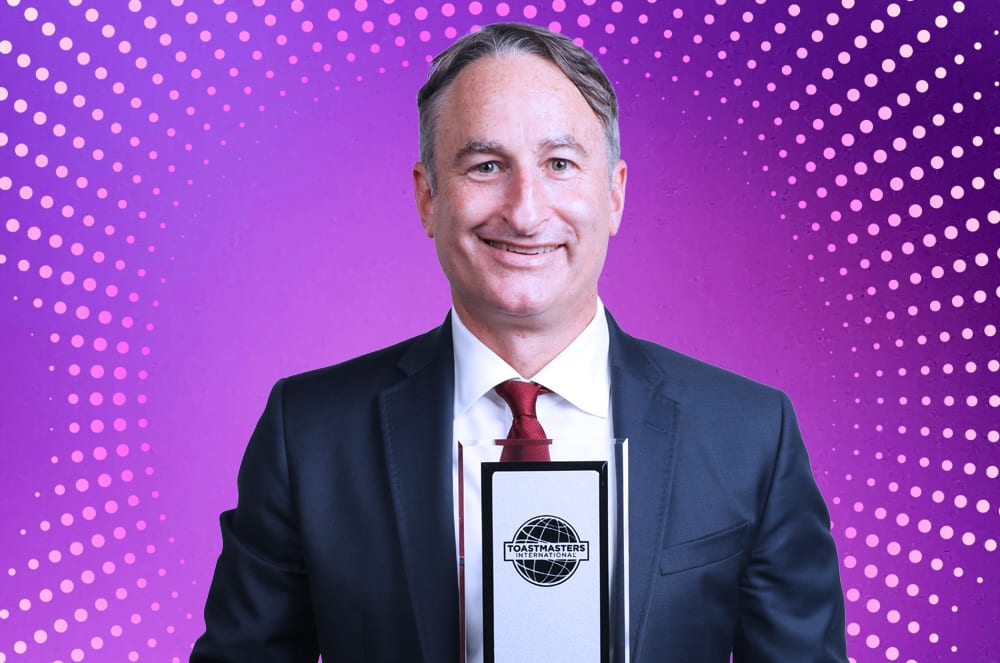
Aaron Samson
By Paul Sterman
On January 7, 2025, Aaron Samson found himself trapped in a terrifying situation: holding on tightly to his father-in-law—who had Parkinson’s disease—as a wildfire raged around them in the Southern California mountains. One of the most devastating wildfires in California history, the Pacific Palisades inferno killed 12 people and destroyed nearly 7,000 structures.
What happened next changed the veteran Toastmaster’s life and became the impetus for a captivating speech that won him third place in the 2026 World Championship of Public Speaking.
In his speech “The Chain,” Samson spotlighted those who stood tall in the crisis, focusing on the unsung actions of people who helped save others—people and pets—even at risk to themselves. Sharing his personal experience, says the Berkeley, California, resident, was “a way for me to honor the heroes of the story.”
Samson, who joined in 2014, belongs to the Puc(k)sters Toastmasters Club in San Francisco. He has excelled in the International Speech Contest, having advanced to the semifinals three times and the final round twice.
A father of three, including two teenagers, he has worked in technology, youth safety, and consumer brands for companies including Meta, TikTok, and Mattel. He is now a keynote speaker who helps parents, educators, school leaders, and teens understand how social media and AI compete for young people’s attention.
“Toastmasters has made me a much more effective communicator throughout my career,” he notes. “Whether I was presenting to executives, pitching an idea, leading a meeting, or speaking to a large audience, I used many of the same skills I developed through Toastmasters: storytelling, structure, audience awareness, and the ability to think on my feet.”
On the January morning chronicled in his speech, Samson was in Southern California helping to care for his father-in-law, Dr. Ronald Carlish. As the day progressed, towering flames spread up the mountains in the Pacific Palisades neighborhood, situated above beach cities like Malibu and Santa Monica. The two men evacuated Carlish’s home—which later burned down—and soon found themselves in a potential life-or-death setting.
During his speech, Samson strode forcefully around the stage, recreating the drama and intensity of the situation. His voice, too, conveyed urgency. He recalled shepherding his father-in-law—who was pushing a walker but showing grit—on the smoke-filled hillside and flagging down a stranger named Jeff, who gave the two men a ride even with fire flanking his car.
Samson’s videos of the dramatic fire went viral and he drew widespread media attention, interviewed by outlets such as the New York Times and People magazine, as well as by CNN anchor Anderson Cooper.
He says his Toastmasters training served him well in such moments.
“Toastmasters is constantly preparing you to speak extemporaneously, especially with Table Topics,” Samson explains, adding that he also benefited from doing the Level 3 Pathways project Prepare for an Interview.
Sadly, three months after the fire, his father-in-law, his Parkinson’s disease worsening, passed away at 83. “I was very close to him,” Samson says.
Looking to the future, he is eager to expand his speaking career, using his platform to help parents, educators, and teens. And he wants to spread his enthusiasm for speaking, and speech contests, to fellow members.
“I’m passionate about speaking and storytelling, and I hope to share that passion and encourage more Toastmasters to compete.”

Share this article


Toastmaster magazine staff is composed of four editorial team members. Learn more about them on the Staff page.
 Previous Article